Starting a fitness journey can feel overwhelming, especially when you are unfamiliar with different exercises and workout techniques. Fortunately, you do not need expensive equipment or complicated routines to become more active. The best exercises for beginners focus on simple movements that improve strength, flexibility, balance, and overall fitness. Learning proper form from the beginning helps make physical activity safer and more enjoyable.
Beginner-friendly workouts can include walking, bodyweight exercises, stretching, and gentle cardiovascular activities. These movements help your body become familiar with physical activity without requiring advanced skills. A balanced routine also allows you to develop coordination and confidence over time. Choosing exercises that match your current abilities is more important than attempting difficult workouts immediately.
Whether your goal is to improve everyday energy, develop muscle strength, or support general well-being, regular movement can help. The key is to choose activities you enjoy and practice them consistently. Gradually building your skills allows your body to adapt comfortably. This guide explains effective beginner exercises, their benefits, correct form, and practical workout tips.
Why Exercise Is Important for Beginners
Regular exercise supports physical and mental well-being in several important ways. It helps strengthen muscles, improve cardiovascular health, and maintain healthy joints. Physical activity can also support better sleep, concentration, and everyday energy levels. For beginners, developing a positive relationship with movement is an important foundation for long-term fitness and personal well-being.
Exercise also helps improve coordination and balance, which are useful during everyday activities. Simple movements such as walking, squatting, and climbing stairs involve muscles that support normal mobility. Practicing these movements can make daily tasks feel more comfortable. Over time, improved physical confidence may encourage people to participate in recreational activities and other enjoyable forms of movement.
Another important benefit of exercise is its connection to emotional well-being. Physical activity can help manage everyday stress and improve mood through several natural processes. Outdoor activities also provide opportunities to enjoy fresh air and spend time in nature. Beginners should focus on discovering enjoyable movements rather than comparing their performance with other people.
1. Walking: The Easiest Exercise for Beginners
Walking is one of the simplest and most accessible exercises for people beginning their fitness journey. It requires no special equipment beyond comfortable footwear and a suitable walking environment. Walking engages muscles in the legs and supports normal cardiovascular function. It can also be incorporated into daily routines without requiring major lifestyle changes or expensive gym memberships.
Proper walking form begins with maintaining an upright posture and keeping your shoulders relaxed. Look forward instead of constantly looking at the ground, and allow your arms to swing naturally. Take comfortable steps rather than deliberately stretching your stride. Choose a pace that allows you to breathe comfortably and hold a conversation without significant difficulty.
Beginners can start with short walks and increase their duration according to personal comfort. Walking through parks, neighborhoods, or safe indoor spaces can make exercise more enjoyable. Comfortable shoes and weather-appropriate clothing help support a pleasant experience. Regular walking can gradually improve endurance, mobility, and confidence while creating a practical foundation for other physical activities.
2. Bodyweight Squats: Build Lower-Body Strength
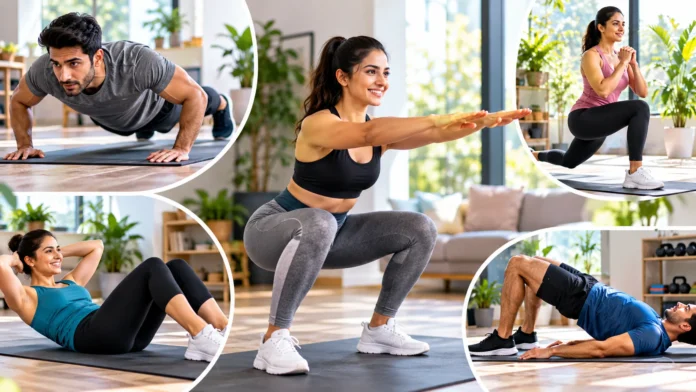
Bodyweight squats are excellent beginner exercises because they strengthen several major muscle groups without requiring equipment. They primarily engage the thighs, glutes, and muscles responsible for stabilizing the body. Squatting movements are also used during everyday activities such as sitting and standing. Learning this exercise can improve movement confidence and support functional lower-body strength.
To perform a squat, stand with your feet approximately shoulder-width apart and your toes pointing comfortably outward. Bend your hips and knees as though you are sitting back into a chair. Keep your feet grounded and your knees moving in the same general direction as your toes. Return to standing using a slow, controlled movement.
Beginners may find chair squats especially helpful when learning the correct technique. Position a sturdy chair behind you and lower yourself until you gently touch the seat. Stand again without rushing or forcing an uncomfortable depth. Focus on smooth movements and comfortable breathing rather than trying to complete a large number of repetitions immediately.
3. Wall Push-Ups: Strengthen Your Upper Body
Wall push-ups are beginner-friendly strength exercises that target the chest, shoulders, and arms. Unlike traditional floor push-ups, this variation uses a standing position to reduce the amount of body weight being supported. It is particularly useful for learning pushing mechanics and body alignment. Wall push-ups can be performed at home without specialized fitness equipment.
Stand facing a sturdy wall and place your palms against it at approximately shoulder height. Position your hands slightly wider than your shoulders and step backward until your arms extend comfortably. Slowly bend your elbows to bring your chest toward the wall. Push through your palms to return to the starting position while keeping your body aligned.
Avoid allowing your lower back to arch excessively or your shoulders to rise toward your ears. Keep your abdominal muscles gently engaged and move at a controlled pace. As the movement becomes easier, you may try push-ups against a sturdy countertop. Practicing suitable variations helps develop upper-body strength and prepares you for more challenging exercises.
4. Glute Bridges: Strengthen Your Hips and Core
Glute bridges are simple floor exercises that primarily strengthen the gluteal muscles around the hips. They also involve the hamstrings and muscles that help stabilize the lower back and pelvis. This movement is useful for developing awareness of hip extension. Beginners often appreciate glute bridges because they require minimal space and no additional equipment.
Lie comfortably on your back with your knees bent and feet resting flat on the floor. Position your feet approximately hip-width apart and keep your arms relaxed beside your body. Gently press through your feet while lifting your hips toward the ceiling. Raise your hips only as far as you can comfortably control without arching your back excessively.
Pause briefly near the top before lowering your hips slowly to the floor. Keep your breathing natural and avoid pushing through discomfort in the lower back. A soft exercise mat can make the movement more comfortable. With regular practice, glute bridges can support hip strength and improve control during other lower-body activities.
5. Bird Dogs: Improve Balance and Core Stability
The bird dog exercise is a gentle movement that helps develop core stability, balance, and coordination. It involves extending opposite arms and legs while maintaining a controlled position. The exercise engages muscles around the abdomen, back, shoulders, and hips. Beginners can use bird dogs to practice maintaining body alignment while different limbs move.
Begin on your hands and knees with your wrists beneath your shoulders and knees beneath your hips. Keep your back in a comfortable neutral position while looking toward the floor. Slowly extend one arm forward and the opposite leg backward. Hold the position briefly before returning to the starting point and switching sides.
Focus on preventing your hips from rotating or your lower back from arching during the movement. If extending both limbs feels difficult, practice lifting only an arm or a leg first. Move slowly and maintain comfortable breathing throughout the exercise. Bird dogs are particularly useful for building coordination without relying on fast or complicated movements.
6. Modified Planks: Develop Core Strength
Modified planks are popular beginner exercises for strengthening muscles that support the torso. They engage the abdominal muscles, shoulders, and other stabilizing muscle groups. Unlike exercises involving repeated bending, planks challenge the body to maintain a steady position. Starting with a modified variation makes it easier to practice proper alignment and controlled breathing.
Begin by placing your forearms and knees on a comfortable exercise mat. Position your elbows beneath your shoulders and extend your body into a straight, comfortable line from your head to your knees. Gently engage your abdominal muscles without holding your breath. Maintain the position only while you can keep your posture steady.
Avoid allowing your lower back to sag or lifting your hips excessively. Short, well-controlled holds are generally more useful than maintaining an uncomfortable position. Rest whenever necessary and gradually develop your ability to hold the posture comfortably. Modified planks can help beginners improve trunk stability while preparing for other strength exercises.
7. Step-Ups: Improve Leg Strength and Coordination
Step-ups are practical exercises that resemble everyday activities such as climbing stairs. They strengthen the quadriceps, glutes, and other lower-body muscles while developing coordination. This movement can also challenge balance in a manageable way. Beginners can perform step-ups using a low, stable platform or the bottom step of a staircase.
Stand facing a secure step and place one foot fully on its surface. Press through that foot to lift your body onto the step without jumping. Bring your other foot up gently before stepping down in a controlled manner. Use a nearby handrail when necessary and keep the movement comfortable throughout.
Start with a low step because excessive height can make the movement unnecessarily challenging. Keep your knee aligned with your foot and avoid rushing between repetitions. Alternate legs when appropriate so both sides receive similar practice. Step-ups can support lower-body strength and help improve confidence during everyday movements involving stairs and uneven surfaces.
8. Standing Calf Raises: Strengthen Your Lower Legs
Standing calf raises are straightforward exercises that target the muscles at the back of the lower legs. These muscles help support walking, standing, and other everyday movements. Calf raises also provide an opportunity to practice ankle control and balance. Their simple technique makes them suitable for beginners who want to develop lower-body strength gradually.
Stand upright with your feet approximately hip-width apart and hold a sturdy chair or countertop for support. Slowly lift your heels away from the floor while keeping your weight distributed across the balls of your feet. Pause briefly at a comfortable height before lowering your heels. Avoid bouncing or using sudden movements to complete the exercise.
Beginners can perform calf raises while holding support until their balance improves. Focus on keeping your ankles aligned and moving through a comfortable range. Wearing stable footwear may provide additional confidence during the exercise. Regular practice can improve lower-leg muscular strength and contribute to better control during walking and other daily activities.
9. Standing Marches: Gentle Cardio for Beginners
Standing marches are simple cardiovascular exercises that can be performed indoors with very little space. The movement involves alternately lifting the knees while maintaining an upright posture. It gently engages the legs, hips, and core while increasing physical activity. Standing marches are particularly useful for beginners who prefer accessible workouts without specialized gym equipment.
Begin by standing comfortably with your feet approximately hip-width apart. Lift one knee to a manageable height and lower your foot back to the floor. Repeat with the opposite leg while keeping your movements smooth and controlled. Allow your arms to move naturally or hold a sturdy support if you need additional balance.
You can perform standing marches at a comfortable pace while listening to music or following a beginner workout routine. Avoid lifting your knees higher than your mobility comfortably allows. Gradually adjust the duration according to your energy and fitness level. This movement is an easy way to include gentle cardiovascular activity during busy days.
10. Seated Knee Extensions: Build Thigh Strength
Seated knee extensions are useful beginner exercises that primarily engage the quadriceps muscles at the front of the thighs. These muscles support standing, walking, and climbing stairs. The seated position provides stability, making the exercise accessible for people developing lower-body coordination. It can also serve as a simple movement during breaks from prolonged sitting.
Sit upright on a sturdy chair with your feet resting flat on the floor. Slowly straighten one knee until your leg reaches a comfortable position. Pause briefly before lowering the foot in a controlled manner. Repeat with the opposite leg while maintaining a relaxed upper body and avoiding unnecessary swinging movements.
Keep your movements smooth and avoid locking the knee forcefully at the top. A stable chair without wheels is ideal for this exercise. Beginners can start without additional resistance and focus on learning the movement. Seated knee extensions provide a simple way to practice controlled leg movements while strengthening the thigh muscles.
11. Dead Bugs: Practice Core Control and Coordination
Dead bugs are beginner-friendly core exercises performed while lying on the back. They help develop coordination between the arms, legs, and abdominal muscles. Unlike fast abdominal exercises, dead bugs emphasize slow, controlled movements and steady trunk positioning. This makes them valuable for people learning how to engage their core during everyday physical activities.
Lie on your back with your arms reaching upward and your knees bent above your hips. Gently tighten your abdominal muscles while maintaining a comfortable position against the floor. Slowly lower one arm overhead and extend the opposite leg toward the floor. Return to the starting position before repeating on the other side.
Only lower your limbs as far as you can without arching your lower back excessively. Beginners may keep their feet closer to the floor or move one limb at a time. Breathe naturally and avoid rushing through the exercise. Practicing dead bugs can improve coordination and help build a stable foundation for other strength-training movements.
12. Gentle Stretching: Improve Flexibility and Mobility
Gentle stretching is an important part of a balanced beginner exercise routine. It helps maintain comfortable joint movement and may improve flexibility over time. Common stretching areas include the calves, hamstrings, shoulders, chest, and hips. Stretching can also provide a relaxing opportunity to focus on breathing and body awareness after physical activity.
Begin with movements that gently lengthen the muscles without causing pain. For example, a standing calf stretch can be performed by placing your hands against a wall and extending one leg backward. Keep the rear heel comfortably grounded while leaning forward slightly. Maintain a relaxed position before changing sides, without bouncing or forcing additional movement.
Stretching is often more comfortable after a gentle warm-up or physical activity when muscles are warmer. Move slowly and avoid pushing joints beyond their natural range of motion. Different people have different flexibility levels, so there is no need to compare positions. Consistent, comfortable stretching can support mobility and make regular movement feel more enjoyable.
How to Maintain Proper Exercise Form as a Beginner
Proper exercise form helps ensure movements are performed in a controlled and comfortable manner. Beginners should first learn the basic technique of each exercise before increasing difficulty. Maintaining stable body alignment and using an appropriate range of motion are useful starting points. Good technique can also improve coordination and help target the intended muscles effectively.
Breathing is another important part of performing beginner exercises correctly. Avoid holding your breath unnecessarily during strength movements because this can increase physical strain. Instead, breathe naturally and maintain a steady rhythm. Taking breaks between movements allows you to recover and concentrate on technique without feeling rushed or excessively tired.
Using a mirror or receiving guidance from a qualified fitness instructor can help you understand movement patterns. Start with simple exercise variations and progress when your form feels reliable. Stop any movement that causes sharp pain, dizziness, or unusual discomfort. Learning correct technique early helps make exercise a more positive and sustainable activity.
How to Create a Simple Beginner Workout Routine
A beginner workout routine should include a combination of cardiovascular activity, strength exercises, and flexibility movements. Walking or standing marches can provide a gentle warm-up before performing bodyweight exercises. Squats, wall push-ups, and glute bridges offer opportunities to practice basic strength movements. Comfortable stretching can help conclude a session while encouraging relaxation.
An example session might begin with a short walk followed by several controlled repetitions of selected strength exercises. Beginners can choose movements based on their abilities rather than trying to perform every exercise immediately. Rest between activities whenever necessary and avoid rushing through unfamiliar techniques. The ideal session length depends on individual fitness, energy, and comfort.
Variety can make beginner workouts more enjoyable and help develop different movement skills. Some days may include outdoor walking, while others focus on simple bodyweight exercises or gentle mobility. Rest and recovery are also important parts of a balanced routine. Gradually adjusting your activities encourages consistency without placing unnecessary pressure on your body.
Common Exercise Mistakes Beginners Should Avoid
One common beginner mistake is attempting advanced exercises before learning fundamental movement techniques. Difficult variations can make it harder to maintain proper posture and control. Starting with accessible versions allows you to develop coordination and confidence. Progressing gradually is generally more effective than selecting exercises based on how challenging or impressive they appear.
Another mistake is ignoring the importance of recovery and comfortable movement. Muscles and joints need opportunities to adapt to unfamiliar physical activity. Exercising through pain or persistent exhaustion can increase the risk of problems. Taking suitable rest periods, sleeping adequately, and eating balanced meals support recovery and general well-being.
Beginners may also become discouraged when comparing their progress with experienced athletes or online fitness personalities. Everyone begins with different abilities, experiences, and physical needs. Exercise should focus on personal enjoyment, skill development, and health rather than competition or appearance. Setting flexible, realistic expectations makes it easier to develop a positive relationship with movement.
Tips to Stay Consistent With Beginner Workouts
Consistency becomes easier when exercise fits naturally into your daily life. Choose convenient activities that you enjoy and can perform without complicated preparation. Walking with friends, practicing simple movements at home, or joining recreational activities can make exercise more engaging. Enjoyment often helps people maintain healthy movement habits over the long term.
It can also help to create a flexible routine that accommodates school, work, family responsibilities, and personal interests. Some days may allow more activity, while others may be better suited to gentle movement or rest. Missing a workout occasionally does not erase previous progress. A sustainable fitness routine should support your overall lifestyle rather than create additional stress.
Pay attention to improvements in movement confidence, coordination, and everyday comfort. Learning a new exercise or finding physical activity more enjoyable can be meaningful progress. Celebrate these experiences without making workouts a source of pressure. A supportive approach helps beginners develop lasting fitness habits and appreciate the many benefits of staying active.
Conclusion
The best exercises for beginners are simple movements that support strength, flexibility, balance, and cardiovascular health. Walking, bodyweight squats, wall push-ups, glute bridges, and gentle stretching provide practical starting points. These activities can be adapted to suit different abilities and experience levels. Learning proper form helps make each exercise safer, more comfortable, and more effective.
Creating a balanced exercise routine does not require complicated equipment or demanding workouts. Beginners can combine basic strength movements with enjoyable cardiovascular activities and mobility exercises. Gradual progression and adequate rest allow the body to adjust comfortably. Choosing activities that match your interests and physical needs makes regular exercise easier to maintain.
Most importantly, physical activity should contribute positively to your everyday life. Focus on developing movement skills, building confidence, and enjoying the experience rather than achieving immediate results. Stay attentive to your body’s signals and adjust exercises when necessary. With patience and consistency, beginner workouts can establish a valuable foundation for lifelong physical well-being.
Frequently Asked Questions
What is the best exercise for a complete beginner?
Walking is an excellent starting exercise because it is accessible, easy to adjust, and requires minimal equipment. Beginners can also try wall push-ups, chair squats, and gentle stretching based on their abilities.
How often should beginners exercise?
Beginners can start with manageable activity sessions and gradually develop a routine that suits their fitness and recovery needs. A combination of enjoyable movement, strength practice, and rest supports long-term consistency.
Can beginners exercise at home without equipment?
Yes, many beginner-friendly exercises require no specialized equipment. Walking, bodyweight squats, wall push-ups, glute bridges, bird dogs, and standing marches can be performed at home with appropriate space and safe surroundings.
How can beginners avoid injuries during exercise?
Start with simple movements, learn correct form, warm up gently, and increase difficulty gradually. Avoid exercising through pain, use stable equipment, and seek qualified guidance if you have injuries or specific health concerns.
What should beginners do before and after a workout?
Before exercising, begin with gentle movements that gradually prepare your body for activity. Afterward, slow down, breathe comfortably, and consider light stretching. Drink water as needed and allow time for recovery.